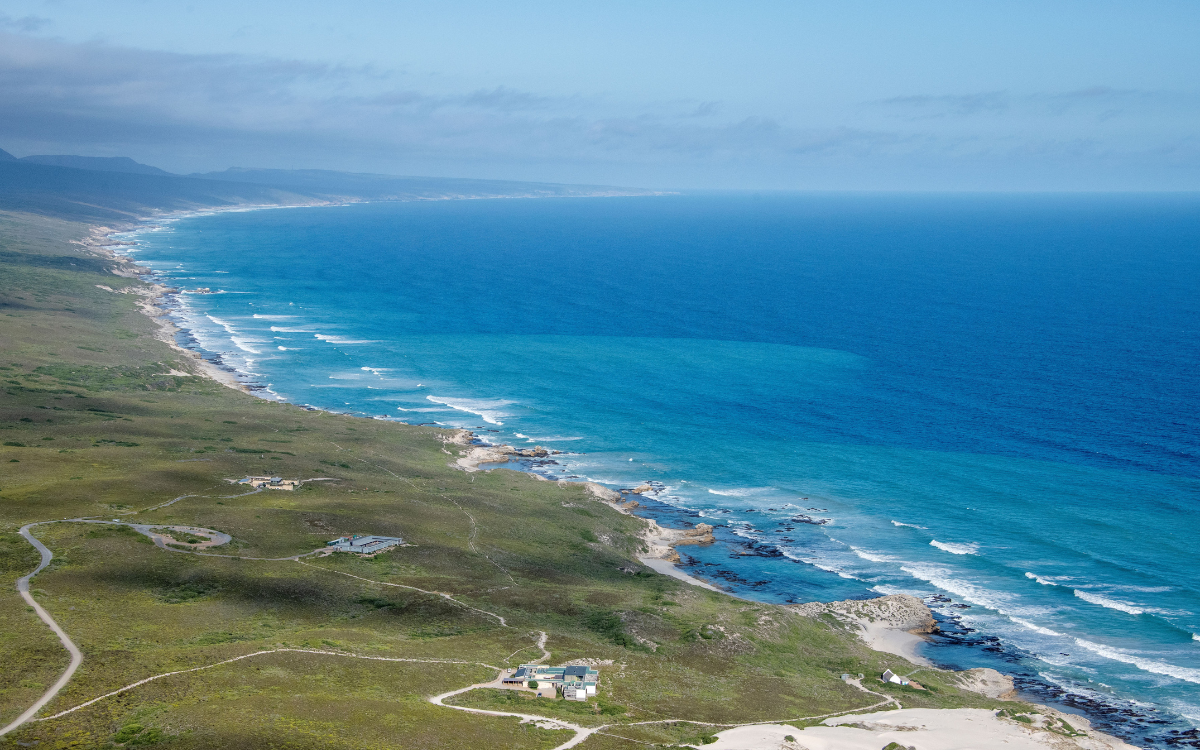
For years, De Hoop Nature Reserve’s leopards have eluded even the sharpest-eyed wildlife enthusiasts. Their tracks tell a story of movement – but actual sightings remain rare. In an effort to change that, the Morukuru Goodwill Foundation, supported by the team at Morukuru Family De Hoop, and with the approval of CapeNature, recently partnered with the Landmark Foundation on a groundbreaking leopard monitoring project.
Using state-of-the-art camera traps, this project will provide crucial insights into leopard density, habitat use, and biodiversity in the reserve, helping conservationists better understand and protect these apex predators. The last leopard survey here was conducted over a decade ago – it’s time for an update.
And just a few weeks into the project – while not quite the big cats we were expecting – the cameras have delivered some incredible footage.
 Caracals! And not just any caracals – a mom and the cutest little baby we’ve ever seen!
For many guests joining the fieldwork day, seeing fresh footage of such an elusive species (especially one recorded in its natural environment, unfiltered) felt like watching a secret window into another world.

Camera traps in action: Phase 1 begins
Over the past few weeks, 22 camera trap stations have been deployed across De Hoop Nature Reserve, each equipped with two motion-activated cameras designed to capture both flanks of any passing leopard. On 27 February, Lauriane Faraut from the Landmark Foundation visited the reserve to retrieve the first batch of SD cards to check what the cameras had picked up so far. Guests from Morukuru Ocean House and Morukuru Beach Lodge joined the fieldwork, standing side by side with conservationists as they accessed the cameras, collected the data, and revealed the first lot of results.
 Caracals! And not just any caracals – a mom and the cutest little baby we’ve ever seen!
Meet the caracal: The feather-catching, sky-leaping phantom of De Hoop Nature Reserve
Agile, powerful, and fiercely independent, this lesser-known predator plays an important role in the ecosystem.- Built for stealth: Slim, long-legged, and lightning-fast, caracals are engineered for the hunt.
- A vertical leap legend: They can jump up to 3 meters high, snatching birds from flight mid-air – an Olympic-level ambush technique.
- A misunderstood predator: Between 1931 and 1952, over 2,219 caracals were killed annually in South Africa’s Karoo region due to human-wildlife conflict.
- The ‘African Lynx,’ except...not really: Despite the nickname, caracals are actually more closely related to the African golden cat and serval.
- A rare sighting: Though they roam freely in De Hoop, they’re incredibly shy, making these camera trap sightings particularly special.
 For many guests joining the fieldwork day, seeing fresh footage of such an elusive species (especially one recorded in its natural environment, unfiltered) felt like watching a secret window into another world.


What’s next in the De Hoop leopard conservation project?
- 22 camera trap stations deployed so far. More locations will be added as we expand monitoring efforts.
- More guest experiences. Future guests at Morukuru Family De Hoop will be able to join SD card swaps to see conservation in action.
- New data rolling in every few weeks. These cameras track leopards, but they also they capture an entire ecosystem - we spotted a dassie (rock hyrax) too. Who knows what we’ll find in the next batch of footage!