


Tucked between fynbos-draped hills and the shores of the Indian Ocean lies De Hoop Nature Reserve – a dazzling corner of South Africa where the wilderness still moves and breathes freely. Beyond its iconic whale migrations and pristine coastal dunes, this 34, 000 hectares of marine protected reserve hums with wildlife. Whether you manage to spot the world’s largest antelope or the most tenacious and elusive little carnivore, every encounter is unforgettable.
 Our nature drives introduce you to a few of them, but many are nocturnal. Thanks to the camera trap project in partnership with Landmark Foundation and CapeNature, we’re getting an even better look at them. Our guides will look out for signs of their presence too – whether that’s droppings, spoor, a feather or quill.
Let’s meet the locals.
In De Hoop Nature Reserve, each hoofprint, flutter, snort, and paw mark tell a story – not of spectacle, but of symbiosis. Of species that have survived, adapted, and thrived in a landscape where ocean, dune, and mountain meet.
A stay here is a slow unravelling of wonder and a reconnection to nature where the wild still feels whole. Come walk the wind-smoothed trails, listen closely, and rediscover the joy of being small in a sprawling, untamed world.
 Our nature drives introduce you to a few of them, but many are nocturnal. Thanks to the camera trap project in partnership with Landmark Foundation and CapeNature, we’re getting an even better look at them. Our guides will look out for signs of their presence too – whether that’s droppings, spoor, a feather or quill.
 Let’s meet the locals.
Eland
Titan of the plains, the common eland is the heaviest antelope on Earth – a muscular heavyweight that can jump nearly 3 metres straight up. Males and females both wear majestic horns, used both for sparring and pulling down branches to feast on. Calves grow up in “nursery herds,” doted on by an antelope auntie network stronger than any village committee. In De Hoop Nature Reserve, you’ll often spot eland grazing peacefully alongside bontebok and zebras.


Bontebok
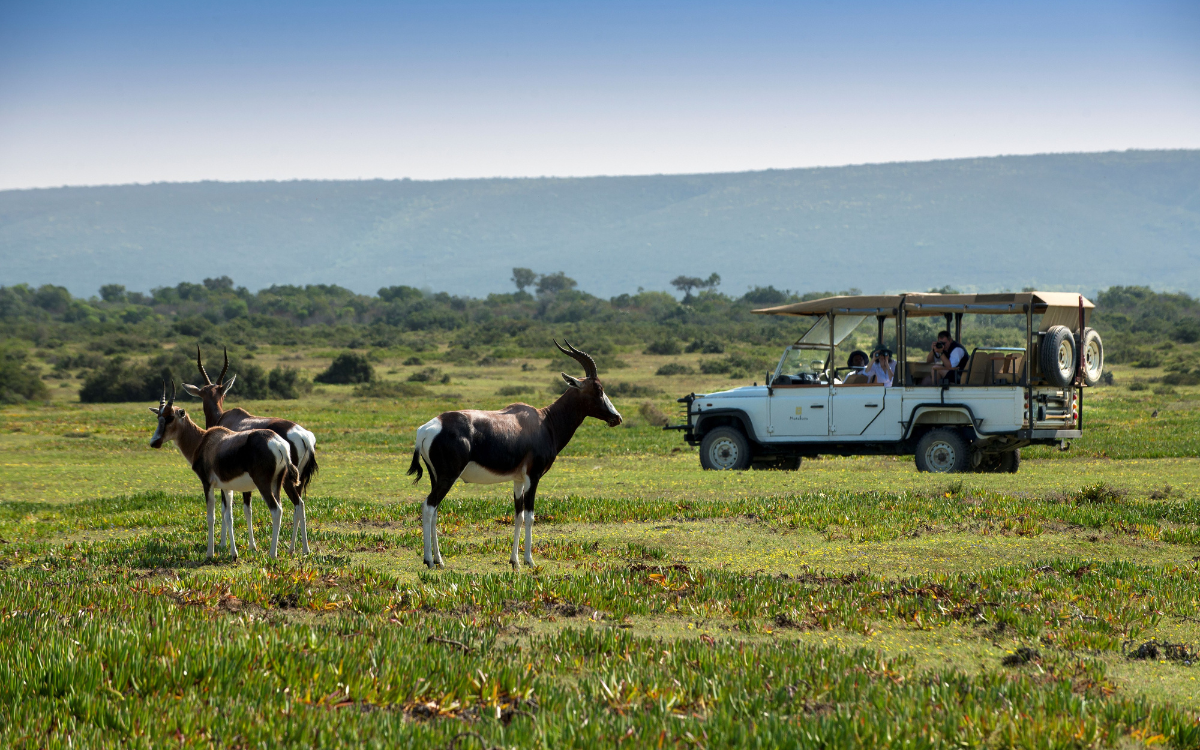
Once nearly wiped from the planet, the bontebok is South Africa’s great comeback kid. With its glossy chocolate coat and a white blaze that looks hand-painted down its face, it stands out against the grasslands it calls home. Not a fan of fences (or hurdles), these antelope are notoriously bad jumpers – a quirk that actually helped save them from extinction in the 1800s. Today, more than 300 bontebok roam the reserve, a conservation success story in motion.
Cape Mountain Zebra
Meet the most stylish stripes in South Africa. The Cape mountain zebra, smaller and stockier than its plains cousins, wears a snappy pinstripe suit with a bright white belly and gridiron rump, with no two patterns quite the same. These agile climbers are right at home in De Hoop Nature Reserve’s rugged terrain; their sharp hooves built for rocky slopes and steep valleys. Once perilously close to extinction, they now thrive here. Watch them closely and you’ll see tight-knit family herds grooming, grazing, and communicating through quiet snorts and flicked tails, their own subtle stripe-language.
Ostrich
There’s no ignoring the ostrich, a 9-foot-tall, dinosaur-footed feather cannonball who can sprint faster than a car in the city. But beneath that slightly ridiculous swagger is a bird built for survival. With eyes the size of billiard balls and legs like coiled springs, ostriches patrol the reserve’s open plains with their small harems in tow. Males do the romancing (and most of the babysitting), guarding a communal nest of watermelon-sized eggs with surprising tenderness. Whether they’re strutting, sprinting, or just giving you the side-eye, they make every wildlife drive feel like a Wes Anderson film come to life.

Caracal
Silent and elegant, the caracal is De Hoop Nature Reserve’s feline phantom. You might never see one (they’re masters of stealth), but trust us, they’re watching you. These reddish-coated cats are acrobatic hunters, infamous for leaping into the air to snatch birds mid-flight. At dusk, they haunt the fynbos and rocky outcrops, leaving only pawprints and owl-like barks in their wake. A flash of those black-tufted ears in the fading light? That’s the reserve working its wild magic.

Chacma Baboon
You’ll likely hear them before you see them. Chacma baboons are social strategists with a flair for drama, living in tight-knit troops ruled by an alpha male and formidable matriarchs alongside the ever-jockeying younger males. Equally at home in the trees or scouring the earth for bulbs and beetles, they’re intelligent, expressive, and endlessly entertaining (from a respectful distance). In the reserve, they move as one – a swirling, bounding ballet of tails and teeth.

Honey Badger
Small in size but colossal in confidence, the honey badger is De Hoop Nature Reserve’s battle-hardened icon. Cloaked in tough skin and tougher attitude, it shrugs off bee stings or snake venom with an unbothered grunt. You’re not likely to spot one (they’re nocturnal, elusive, and on a solo mission) but just knowing they’re out there makes your surroundings feel a little more untamed. They dig, they charge, they steal honey... and hearts. If the reserve had a superhero, the honey badger would wear the cape (and then tear it to shreds and use it to build a den).
Mongoose
During your stay, you just might spot a yellow mongoose basking on a sun-warmed rock, tail curled like punctuation and eyes scanning for beetles or gossip. There’s mischief behind that twitchy nose. Meanwhile, the small grey mongoose prefers to stay in the shadows, sneaking through thickets like a furred rumour. Both species keep the ecosystem stable, acting as much-needed pest control (with panache).
Cape Porcupine
The Cape porcupine may look like a walking pincushion, but those quills are nothing to laugh at! When threatened, this little guy turns into a foot-stomping, quill-rattling, backwards-charging force of nature. Mostly, though, he keeps to himself, nibbling on roots and bulbs under cover of darkness, turning the soil with every snuffle and dig. Rarely seen but sometimes revealed by a scatter of quills on a trail, the Cape porcupine is proof that some of the wildest stories unfold after sundown.
Large Spotted Genet
Picture a feline crossed with a mongoose wearing a cheetah-print coat. That’s the large spotted genet, De Hoop Nature Reserve’s tree-leaping enigma. It’s maddeningly secretive, hunting alone and living in shadows (mostly nocturnal), moving with quiet elegance through thickets and treetops.
Cape Grysbok
The Cape grysbok is knee-high, rust-coloured, and challenging to spot. Endemic to the Western Cape, these pint-sized antelope are nocturnal specialists, slipping through dense shrubbery on tiptoe hooves. During the day, they vanish into thickets, perfectly camouflaged by their flecked coats and quiet nature.
Bushbuck
Graceful, solitary, and sharply dressed in white stripes and chestnut tones, the bushbuck is the introvert of the reserve’s diverse antelope set. Preferring the company of dense thickets and twilight hours, it moves like a whisper, one careful step at a time. Males sport elegant spiral horns and a broody presence, while females keep low, blending perfectly into riparian forests and riverside fynbos. You’ll need patience to find them, but when you do, it’s always a quietly thrilling moment.
Bushpig
Move over warthog. The bushpig is tougher, grubbier, and prefers to go about his business after sunset. With shaggy coats, sharp tusks, and a love for roots and bulbs, these pigs are built for stealth and surprise. They snort, grunt, and charge if startled, living in tight family sounders deep within De Hoop Nature Reserve’s thickets. Rarely seen but often heard rustling through the undergrowth, bushpigs carry a certain mystery… kind of like forest-dwelling rock stars with mud on their boots.
Striped Polecat
Imagine a tiny carnivore dressed like a punk rock skunk… that’s the striped polecat. Black-and-white and impossible to ignore, it’s armed with attitude and a truly unforgettable defensive spray (trust us, leopards don’t go back for seconds). Mostly nocturnal, it roams the reserve’s open scrub and grasslands hoping for a snack - perhaps a juicy scorpion. In De Hoop Nature Reserve, each hoofprint, flutter, snort, and paw mark tell a story – not of spectacle, but of symbiosis. Of species that have survived, adapted, and thrived in a landscape where ocean, dune, and mountain meet.
A stay here is a slow unravelling of wonder and a reconnection to nature where the wild still feels whole. Come walk the wind-smoothed trails, listen closely, and rediscover the joy of being small in a sprawling, untamed world.
