World Turtle Day: A Reason to Celebrate… and to Keep Going
There’s a moment, if you are lucky enough to witness it, when a sea turtle meets the ocean again. She is carried down the sand and placed at the water’s edge. She pauses, as if remembering something ancient, and then she’s gone.
We’ve been fortunate enough to witness that moment more than once on the shores of De Hoop Nature Reserve. It never stops being extraordinarily emotional. On World Turtle Day (and everyday really), we find ourselves reflecting on what those moments mean, and why the work that makes them possible matters more than ever.
Nori (c) Two Oceans Aquarium Foundation
A reason to celebrate and to keep going
In October 2025, the green turtle (Chelonia mydas), once listed as Endangered on the IUCN Red List of Threatened Species, was reclassified as Least Concern. It’s one of the most significant conservation wins in recent marine history and the result of decades of coordinated global effort.
It’s worth pausing to appreciate what that means. Conservation works. The needle moves when humans commit to protecting a species. But the reclassification is not the finish line.
Because while the green turtle’s story is cause for genuine celebration, the broader picture remains urgent. All seven species of sea turtle are conservation dependent. Loggerhead, leatherback, and olive ridley turtles are listed as Vulnerable. Hawksbill turtles are Critically Endangered. The threats (bycatch, habitat loss, plastic pollution, climate change) haven’t disappeared. They’ve simply been outpaced, in some regions, by the determination of the people working against them. For now.
Five species & an enormous responsibility
Of the seven species of sea turtle found in the world’s oceans, five visit South African waters: the loggerhead, the green, the hawksbill, the leatherback, and the olive ridley. The odds these animals face from birth are staggering. Only one or two out of every thousand hatchlings survive to adulthood under natural conditions, and that’s before accounting for the intensifying pressures of human activity. To reach sexual maturity at around thirty years of age, a turtle must beat the odds of predation and disease while also navigating plastic-filled oceans.
Their highly migratory nature compounds the challenge. The green turtles that visit South African waters travel vast distances through multiple ocean habitats before they reach our shores.
South Africa plays a special role in the global turtle story. The northern KwaZulu-Natal coastline is one of the most important loggerhead and leatherback nesting sites in the world, where females return each season to lay their eggs on the same beaches where they themselves hatched. Each summer, thousands of hatchlings enter the warm, fast-flowing Agulhas Current and begin their journey. Some of them do not make it far. Swept westward into the colder waters of the Western Cape, they wash up on beaches, weak and dehydrated. This is where the Two Oceans Aquarium Foundation’s Turtle Rescue Network steps in: a chain of trained organisations and individuals along the coastline who respond to strandings, provide temporary care, and coordinate transport to the Turtle Conservation Centre in Cape Town.
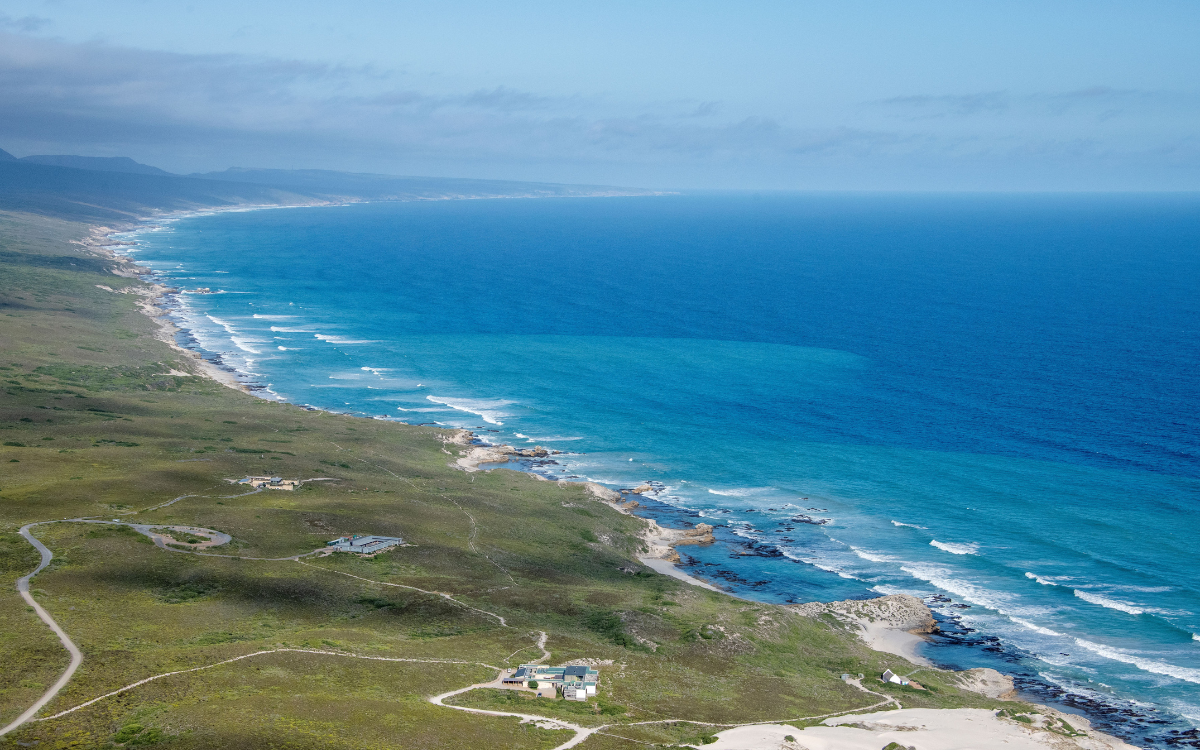
De Hoop Nature Reserve
Since 2009, more than 1300 turtles have been rescued, rehabilitated, and released through this programme. The centre maintains an 85% release rate, a figure that represents an extraordinary commitment to giving every animal its best possible chance.
De Hoop Nature Reserve sits at the heart of this network. As a Marine Protected Area (a no-take zone where species are actively flourishing), it has become a significant release site for rehabilitated turtles on the South African coastline. In the last eight years, the Turtle Conservation Centre has received seven live green juvenile and sub-adult turtles from the reserve alone.
The team at Morukuru Family De Hoop are proud to participate in and support this journey.
The community that rescues turtles
On 5 September 2025, our marine guide Corné was patrolling the dunes at De Hoop when he spotted a very weak green turtle on the sand. With nothing but his shirt to shield her from the sun and wind, he carried her two kilometres back along the beach and radioed his wife. She called the Turtle Rescue Network, and by the time that turtle (later named Bayleaf) arrived safely at the Turtle Conservation Centre in Cape Town, 11 people had played a part in getting her there.
Three months later, on Boxing Day, another call came in. A member of the public had found a turtle entangled in a ghost fishing net on the De Hoop shoreline and, with the best of intentions, had released it back into the water. Fortunately, the exhausted animal restranded before it could drown. (An important reminder: if you ever find a stranded turtle, please don’t return it to the sea. Call the Turtle Rescue Hotline on 083 300 1663 immediately.) Corné retrieved her, wrapped her carefully, and began the three-hour drive to Cape Town.
That turtle turned out to be an olive ridley – a species not often seen in South African waters, and the smallest turtle species found here. The team at the Turtle Conservation Centre named her Sage, for her greenish colouring. She arrived with deep wounds from her entanglement and a pneumocoelom – an air pocket caused by a torn lung lining, the likely result of prolonged hyperventilation during her ordeal. Under the expert care of veterinarian Dr Bernice van Huyssteen, she has been receiving antibiotics, regular aspiration procedures to relieve the pressure on her system, and a carefully designed enrichment programme to keep her mentally and physically engaged as she heals. As of May 2026, Sage is well on her way to recovery.
These rescues are the result of a trained and deeply committed team on the ground, and of the Morukuru Goodwill Foundation’s long-standing partnership with the Two Oceans Aquarium Foundation, which ensures that when a turtle needs help on this stretch of coastline, there’s a network ready to respond.
The turtles we’re watching
The Morukuru Goodwill Foundation’s three-year commitment to the Turtle Conservation Centre funds the complete care and rehabilitation of three remarkable animals: Nori, Habanero, and Kai. It also funds expanded rehabilitation facilities and, crucially, satellite tracking post-release, because the story does not end when the turtle meets the water.
Nori feeding (c) Two Oceans Aquarium FoundationNori is proof of that. Released into the De Hoop Marine Protected Area in November 2025, this green turtle has since travelled 6,320 kilometres, averaging 41 kilometres per day. As of early May 2026, the island of St Helena is just 750 kilometres to her left. The Turtle Conservation Centre team has been in contact with the Marine and Fisheries Conservation Section of the St Helena Government, who have shared what Nori might encounter should she pass through those waters: seamounts teeming with marine life, schools of tuna, visiting humpback whales, and fellow green turtles navigating the same mid-Atlantic currents. Nori’s satellite tag, sponsored by the Morukuru Goodwill Foundation, is not just tracking one turtle. It’s building a global picture of how rehabilitated green turtles move through the ocean after release, data that will improve outcomes for every turtle that follows her.
Habanero, the adult male loggerhead rescued from a Witsand slipway in February 2025, continues his recovery. Adult male turtles spend their entire lives at sea and almost never return to shore, which makes rescued males like Habanero genuinely exceptional, and, in a world where climate change is pushing sea turtle populations toward female-heavy imbalances, his survival carries real significance for the species. He is doing well, and we are watching his progress closely.
Habanero in final rehab in the I&J Ocean Exhibit (c) Two Oceans Aquarium
And then there’s Kai. His story began in October 2020 when he washed up as a hatchling weighing just 530 grams, already fighting a lung infection and buoyancy issues so severe he floated vertically in the water. Six years later, after pulmonary physiotherapy, custom shell weights, and a purpose-built buoyancy device that is as ingenious as it sounds, Kai weighs a healthy 100 kilograms. On 15 May 2026, just over a week before World Turtle Day, he was released into the De Hoop Marine Protected Area. True to his name, which means “sea” in Hawaiian, Kai was always destined to return to the waves.
Kai, a juvenile loggerhead turtle, makes his way into the protected waters of the De Hoop Marine Protected Area during his release after six years of rehabilitation at the Turtle Conservation Centre at the Two Oceans Aquarium (c) Two Oceans Aquarium
Coastal conservation with a purpose
At Morukuru Family, we believe our presence here comes with an obligation to contribute to the reserve’s health and its future. Right now, we are encouraged and grateful for the wins. And we intend to continue offering our support to the TOAF Turtle Conservation Centre in any way we can.
For guests who want to go deeper, our Coastal Conservation with a Purpose package offers exactly that opportunity. Available to guests staying two or more nights at Morukuru Beach Lodge or Morukuru Ocean House, the package includes a behind-the-scenes visit to the TOAF Turtle Conservation Centre in Cape Town, timed to coincide with your stay, either before or after your time at De Hoop. You’ll meet the team, see the rehabilitation work up close, and understand firsthand what it takes to give a turtle a second chance at the ocean. Your visit directly supports the centre's research, conservation, and education work.
Because this is what we mean when we talk about luxury with purpose. Not a property that simply exists in a beautiful place. A property that takes responsibility for it.
If you find a stranded turtle anywhere on the South African coastline, do not return it to the water. Call the Turtle Rescue Hotline immediately: 083 300 1663.


 We’ve been fortunate enough to witness that moment more than once on the shores of De Hoop Nature Reserve. It never stops being extraordinarily emotional. On World Turtle Day (and everyday really), we find ourselves reflecting on what those moments mean, and why the work that makes them possible matters more than ever.
 We’ve been fortunate enough to witness that moment more than once on the shores of De Hoop Nature Reserve. It never stops being extraordinarily emotional. On World Turtle Day (and everyday really), we find ourselves reflecting on what those moments mean, and why the work that makes them possible matters more than ever.



 That turtle turned out to be an olive ridley – a species not often seen in South African waters, and the smallest turtle species found here. The team at the Turtle Conservation Centre named her Sage, for her greenish colouring. She arrived with deep wounds from her entanglement and a pneumocoelom – an air pocket caused by a torn lung lining, the likely result of prolonged hyperventilation during her ordeal. Under the expert care of veterinarian Dr Bernice van Huyssteen, she has been receiving antibiotics, regular aspiration procedures to relieve the pressure on her system, and a carefully designed enrichment programme to keep her mentally and physically engaged as she heals. As of May 2026, Sage is well on her way to recovery.
These rescues are the result of a trained and deeply committed team on the ground, and of the Morukuru Goodwill Foundation’s long-standing partnership with the Two Oceans Aquarium Foundation, which ensures that when a turtle needs help on this stretch of coastline, there’s a network ready to respond.


 Habanero, the adult male loggerhead rescued from a Witsand slipway in February 2025, continues his recovery. Adult male turtles spend their entire lives at sea and almost never return to shore, which makes rescued males like Habanero genuinely exceptional, and, in a world where climate change is pushing sea turtle populations toward female-heavy imbalances, his survival carries real significance for the species. He is doing well, and we are watching his progress closely.


 Because this is what we mean when we talk about luxury with purpose. Not a property that simply exists in a beautiful place. A property that takes responsibility for it.